Hydrocyclone Filter Working Principle and Application Areas
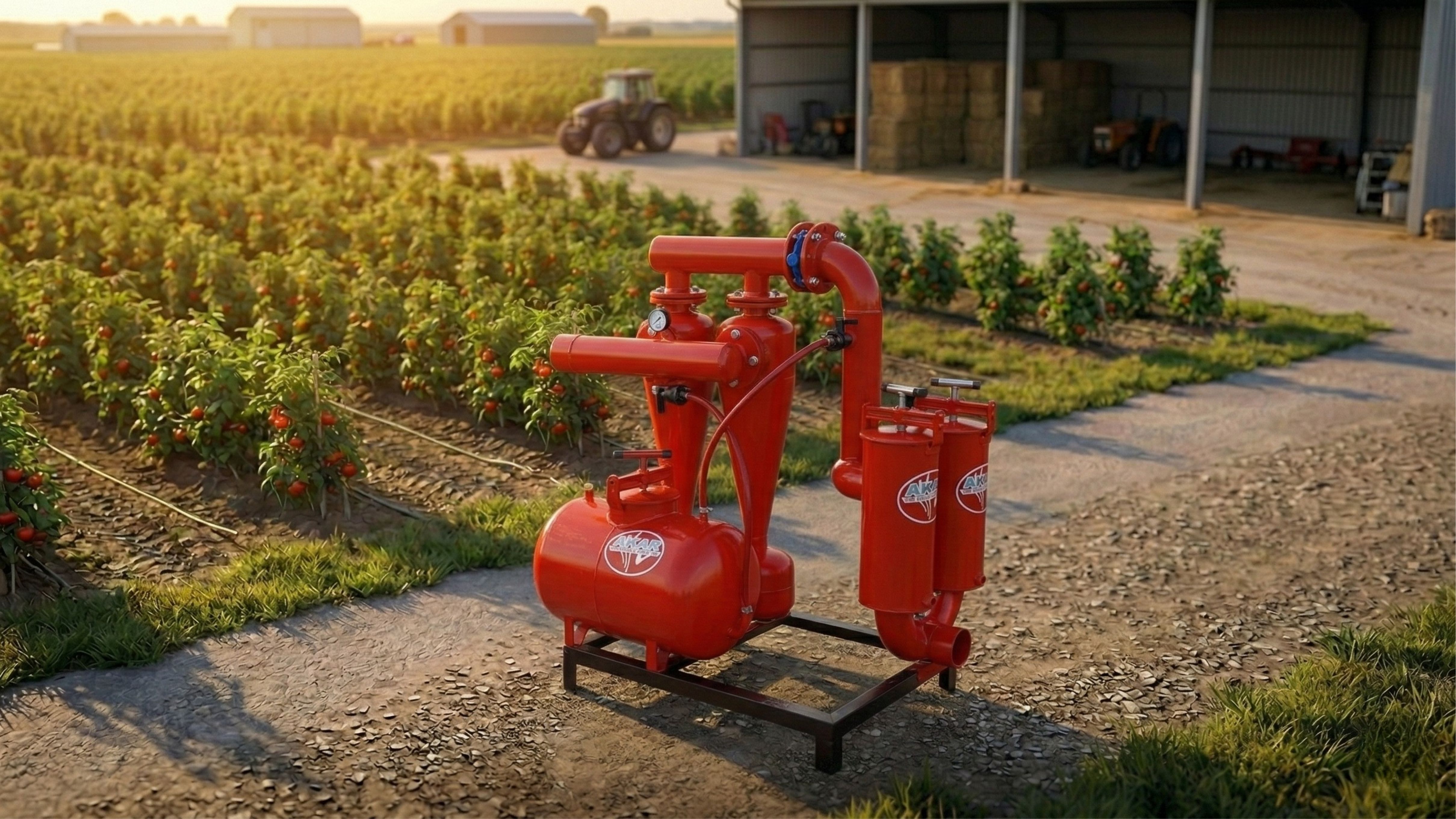
As a basic purpose, the hydrocyclone allows the classification or separation of solid particles from a liquid based on differences in density and size. Furthermore, there are types used to separate liquids with different densities from each other. Of course, within drip irrigation systems, the hydrocyclone filter also efficiently supports the cleaning of pipes.
Hydrocyclone filters, which are used in the filtration of waters containing heavy particles, stand out with their simple structural design and the fact that they contain no mechanical parts. With this simple structure, the hydrocyclone filter type can surpass other filter models both economically and functionally. Hydrocyclone filter models have the advantage of minimum pressure loss and operate with maximum efficiency during the filtration process. Hydrocyclone filters can be used in single or modular form to perform manual or fully automatic cleaning operations.
Hydrocyclone Filter Structure
Hydrocyclones, which do not contain mechanical parts, are produced in a cylindroconical shape. Their diameters vary from a few centimeters up to 2.5 meters. Physically, hydrocyclone filters consist of five different parts: the upper cylindrical body, the lower conical body, the feed inlet, the coarse material outlet (underflow), and the fine material outlet (overflow). The structure includes one inlet and two outlets. The outlet located at the top is called the fine material outlet pipe, while the one at the bottom is called the coarse material outlet pipe. The fine material outlet pipe allows the fine material to exit the hydrocyclone. The coarse material outlet pipe, which is the smallest part in diameter, is known as the underflow and is made of wear-resistant material, either fixed or replaceable.
The hydrocyclone filter, which contains no moving parts, uses the velocity of water for the classification of materials. With the increase in water speed, efficiency in separation or classification processes improves. In the design of the hydrocyclone filter, parameters such as the particle size for separation, the separation percentage (i.e., what percentage of the particle size will go to the underflow or overflow), the pressure difference between the underflow and overflow, and the density of the fluid to be used (e.g., water) are determined.
Hydrocyclone Working Principle
In the working structure of the hydrocyclone filter, the main effect is water. The materials entering the hydrocyclone filter by water pressure are subjected to two main forces: drag and centrifugal force. The centrifugal force generated throws the particles with higher densities toward the inner surface of the cone, where the velocity is lower. Conversely, due to the drag force, some particles move toward the area of lower pressure. As a result of these centrifugal and drag movements, materials with higher density move downward, while those with lower density move upward through the central part of the hydrocyclone. At the end of these movements, the unwanted materials are expelled from the hydrocyclone.
The main parameters affecting the efficiency of the hydrocyclone are the flow rate of the supplied material and the pressure difference in the cyclone. It should not be overlooked that the supplied material, which is water, must be under the same conditions. As the water flow rate increases, the separation efficiency also increases.
For the operation of the hydrocyclone filter system, the purified water enters the upper part of the hydrocyclone tangentially toward the wall and moves downward in a spiral motion along the wall. Then, as this water rises upward through the central section, sand particles remain at the bottom due to their weight. At the top of the hydrocyclone filter’s physical structure, an air release device (air vent) is installed to discharge air. After these processes, the sand accumulated in the bottom section is cleaned at certain intervals by opening the drain valve in the chamber. The valve is opened when irrigation is not being performed.
Hydrocyclone Filter Application Areas
Especially for groundwater, hydrocyclone filter types are used to classify solid particles by utilizing differences in density or size. The hydrocyclone filter, as a device used to separate particles from a liquid, is particularly used in agricultural irrigation. It is also used in industry to separate liquids with different densities from each other.